One of those rare events. I have taken some time out of my otherwise boring day and created for you, an original list.
For almost 50 years Star Trek has shown us many glimpses of the future. Other worlds and aliens, ships that fly faster than the speed of light, the technology to create food out of thin air and, of course, green women.

But placing the adventurous story lines aside many people don't realise that the science within the show isn't just a bunch of geeky sounding works the writers have stitched together using a Trekkers Nerdictionary. Many of the things the shows characters run into in the show are based on real scientific theories and, as a result, all the gadgets they use to get themselves out of the situations are also based upon those same theories.
However after 50 years science fiction has become science fact and, while we are still lacking those green women, inspired scientists have struggled on and have created for us many pieces of trek technology. I'll bet you didn't even know about some of them.
1)
Trek Name: Phaser.
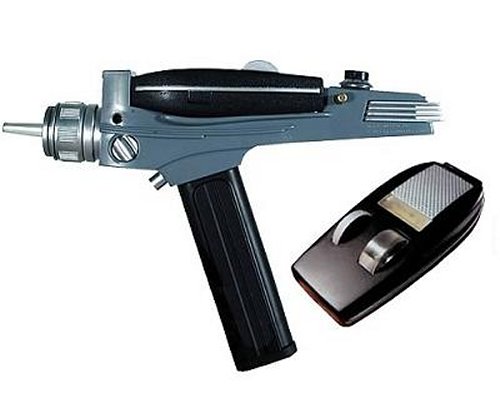
As much a part of the show as the warp core, the transporter or William Shatner's hairpiece. The phaser was the weapon of choice to ensure your survival against that evil alien attacker. Provided you weren't wearing a red shirt of course, then you might as well have left the weapon at home and taken your fully updated will along instead.
The phaser had two modes, stun and kill, and a variety of settings from Light Stun; leaving your opponent dazed but conscious to the dreaded Maximum Setting; vaporising your enemy instantly.
Real Life Equivalent: Taser

Specifically the
UV Laser Stun Gun. This prototype stun gun uses a laser beam of UV light to deliver the shocking blow to your would-be attacker. The Ultra-Violet light ionises the air and, as any weather man will tell you, ionised air is very good at conducting electricity. Just look out the window during a lightning storm. Just as lightning follows ionized air down to the ground the electrical charge of your Taser follows the ionised laser beam to your target.
That's right people, you get to say "I took that mugger down with a bolt of lightning!"
[ame]http://www.youtube.com/watch?v=Bqqy-kFre8k[/ame]
2)
Trek Name: Communication Ear Piece

Seen throughout the original series hanging off Uhura's head. She would use this piece of metal to listen to communications in private so she didn't disturb the rest of the bridge crew until she had to relay that all important message.
Real Life Equivalent: Bluetooth Headset

Maybe a little more stylish but certainly a lot less private than the one Uhura used. When we use one of these things EVERYONE can hear what we're talking about, because we have to yell to be heard on the other side.
We've had these little suckers since 1998 and they have gone from making you sound like you're shouting down a tin can to making you sound like you're talking directly into a tin can. While Uhura could use her to talk to the landing party, other parts of the ship and starfleet command all at the same time, ours struggle to talk to our mate Dave when we're more than 8 feet away from our phones.
3)
Trek Name: Padd
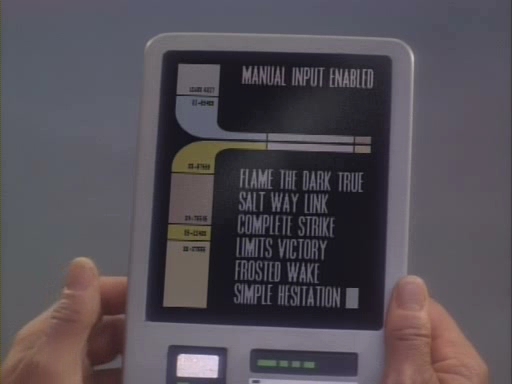
In Trek you would be lost without your trusty Padd. It could do everything, help you write that speech, display that new duty roster for you to sign, draw pictures, display any piece of information you wanted from the library computer without the need of the desk top monitor, play a few computer games and even be the notepad you write your novel on.
Padd's were the portable display unit all characters from Officers, to the guy on the street, used for all their information purposes.
Real Life Equivalent: Tablet PC's and iPad's.


Arriving in 2001, tablet PC's became the first portable medium that could perform all the tasks a Padd could do. You could draw your pictures, write your report and, providing you had a phone line to plug into, surf the net to grab any piece of information you like. Their only downside was their weight, you could throw your back out with one of those things, and the battery life, two hours at their very best.
Fast Forward only 9 years and we have the iPad. A device that not only is smaller and infinitly lighter than a tablet PC with a battery life of up to 12 hours. They can connect you up to the internet, write your speech, show you a book, play your games and...well you've seen the commercials, I'm sure.
I wonder if we'll still have YouTube and Wikipedia in the 24th centuries.
4)
Trek Name: Lithium Crystals.

In
Star Trek, the original series episode "
Where No Man Has Gone Before" it was told how lithium crystals were used for power regulation of the ship. When overloaded they had a tendency to shatter. A single crystal was capable of running the entire ships power through it for some period of time, even though it wasn't supposed to. For all their fusion reactors, and the immense energy within their warp core, the ship is dead in space without these crystals.
Real Life Equivalent: Lithium Cell Batteries.

Running everything in the world from your digital watch to your cell phone, from your laptop to the above iPad, they are even used in pacemakers. Lithium batteries have outstripped their alkaline ancestors by leaps and bounds in terms of safety during recharging (alkaline batteries had a habit of exploding if overcharged) and power life. Many times the battery itself actually outlasts the device it's plugged into. The world of portable gadgets as we know it just wouldn't be the same if not for these little things.
5)
Trek Name: Transparent Aluminium.

Star ships of the future did not use glass in their windows. Perhaps it was too brittle. Maybe it turned to liquid inside a warp field or something. All the same, a form of aluminium (yes the metal in your drinks cans) was used instead. This aluminium was as transparent as glass while still being as strong as the metal itself. It could be thinner, lighter, and the panes could be larger than regular glass and could be twisted and curved into a variety of interesting shapes. In Star Trek: The Next Generation huge curved panes of the transparent aluminium lined almost every wall of the Enterprise.
Real Life Equivalent: Transparent Alumina

Yep, we got that. As far as I know it wasn't invented by some Scottish fellow who constantly harped on about how you "can't change the laws of physics!"
Over twice as strong and light as steel yet as transparent(ish) as glass the current challenge is how to mass produce this expensive material. The second challenge is how to make it completely clear as it has already been planned for use on the next generation of space shuttles and military vehicles.
So when Space tourism becomes the big thing and you board your Virgin Galactic shuttle, you may well find yourself looking out of a window made of transparent alumina.
The number of applications for this are huge. Imagine an entire skyscraper or arcology made largely of transparent steel. The skylines of the future could look more like a series of floating black dots (opaque private rooms) rather than the monoliths of today. A huge space station made of transparent alumina could cruise in low Earth orbit without being a creepy black dot when it passes overhead. And hey...
transparent swords!
6)
Trek Name: Hypospray.
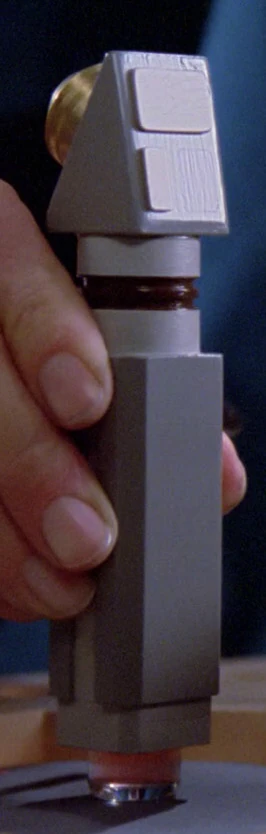
Used, in the trek universe, since the early 22nd century. The Hypospray, commonly called a Hypo, was a method of injecting various drugs into a patient without the need of painful needles which can lead to infection in the injection point. They have also been seen extracting blood in the same manner. The device uses super-compressed air to fire the drugs directly through the layers of skin and into the blood stream. So powerful is this spray that it can even inject a person through their clothing.
Real Life Equivalent: Jet Injector.
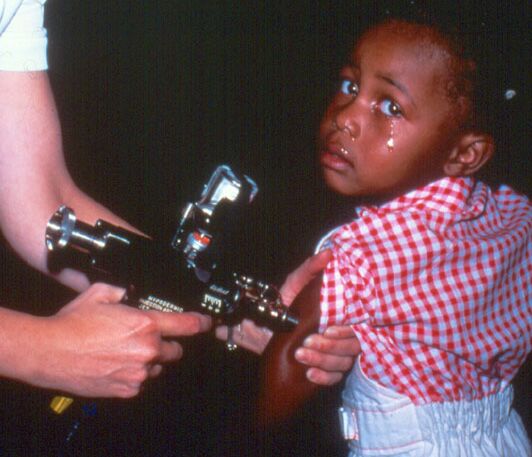
Created way back in 1962 many people feel it was the inspiration for the Hypospray (Star Trek first coming into being in 1966). This medical device uses compressed air to administer injections in an extremely efficient manner. It is usually called into action in places where there is a shortage of hypodermic needles and large numbers of people requiring treatment, third world countries for example.
Unlike its fictional Hypospray cousin however, it is reported that this device is not painless. It is however quicker and safer than hypodermic needles, capable of injecting up to three people at a time on one bottle of medicine the gun itself can be used over and over again with no risk of cross infection to patients.
7)
Trek Name: Cloaking Device.

Used by enemies since the 23rd century. A cloaking device, seen in use above, is a form of stealth technology that uses selective bending of light (and other forms of energy) to render a starship or other object completely invisible to the visual and electromagnetic spectrum and most sensors. Used mostly by the Klingons and Romulans to patrol their borders and perform sneak attacks on their enemies. The only weakness of the cloaking device is that one cannot fire ships weapons when cloaked; the necessary power being channelled to the cloaking field itself.
Real Life Equivalent: Active Camouflage.

Displayed all over the internet and on gadget shows across almost every TV channel. They're commonly known as
Invisibility Cloak's and can mostly owe their inspirations to Harry Potter more than star trek.
As well as letting geeks flip out about the thought of invisibility, and what they could do with it, the various military organisations of the world are also very interested in perfecting the technology.
It's known as Active Camouflage because unlike regular camouflage, a series of coloured blobs designed to help you blend into the background, the system uses a camera to picture what it directly behind it and displays the image on the front of the garment, almost like a wrap around tv screen. The plus side is that the image on your front changes as you walk, allowing you to blend in perfectly with what ever your surroundings are. The downside, right now, is that you have to lug around a huge HD camera and a computer packed the software you require. Lots of trailing wires and heavy battery packs. The Camera's are only at their most effective when stationary anyway. The material of the garments are expensive, easily damaged and, as you can see above, aren't perfect. However, as long as you stay perfectly still and the person looking at you is very short sighted, you can be rendered pretty much invisible.
8)
Trek Name: Tricorder.

The greatest tool a starfleet officer can have besides the starship itself. There doesn't seem to be anything that this little toy can't do. Using their scanners they are capable of doing almost any task from sensing faults and broken parts in engineering equipment, to detecting radiation, conducting DNA, and medical, scans of a persons body, detecting temporal radiation (yep they can tell you if a time traveller has been nearby), picking up ores and gasses contained in tunnels and walls, access library computer information, had inbuilt universal translators, could scan for something called sub-space fractures (holes in the universe as near as I can tell), and could connect up with various computer equipment and act as remote controls to open doors and turn computers on and off.I think once they were even used to detect molecule displacement in air particles to detect whether or not a person walked though a room.
Real Life Equivalent: Miniature Mass Spectrometre.

This small, handheld device, is about thirty centimetres high and sixty long. Developed by Purdue University in Aston, Pennsylvania. Far from scanning grains of dust on alien worlds the device has been built to have more down to earth applications such as testing foods for dangerous bacterial contaminants including salmonella. The above device was used to detect trace amounts of Salmonella in a 500g jar of peanut butter in a fraction of the time standard testing methods use. The Mini-10 is the latest generation is these portable scanners. The new portable system is an ultrafast chemical-analysis tool that has numerous promising uses for detecting everything from cancer in the liver to trace residues of explosives on luggage and "biomarkers" in urine that provide an early warning for diseases.
9)
Trek Name: VISOR

As seen on the face of Geordi LaForge throughout Star Trek: The Next Generation. The
VISOR, acronym for
Visual
Instrument and
Sensory
Organ
Replacement, was a medical device used in the Federation to aid patients who have suffered loss of eyesight or who were born blind.
The VISOR detected across the entire EM spectrum and transmitted those signals to the brain through neural implants in the temples of the individual. The result was a vastly different visual acuity, with VISOR-wearers able to see in the infrared and ultraviolet ranges and beyond. However it came at the cost of being able to see almost nothing of the visual light spectrum. To normal Human eyes, the images relayed through the VISOR could seem disorienting and unfamiliar.
Real Life Equivalent: JORDY

Named after the star trek character some clever nerd managed to assign meaning to it. The
JORDY:
Joint
Optical
Reflective
Displa
y device, was designed and manufactured by a privately-held medical device company known as
Enhanced Vision. It enables people with low vision to read, write, and watch television. Low vision, which includes macular degeneration, diabetic retinopathy, and glaucoma, describes eyesight that is 20/70 or worse, and cannot be fully corrected with conventional glasses.

The headset contains two eye-level cameras, one with an unmagnified wide-angle view and one with magnification capability. This system manipulates the camera images to compensate for a person's low vision limitations. JORDY magnifies objects up to 30x. When placed in its docking stand, it magnifies up to 50x. The user can also adjust the contrast, brightness, and display modes, depending on what works best for their condition.
NASA are very interested in making the tecnology smaller, less expensive and more portable. Their astronauts to use the JORDY to enhance their vision for work on delicate tasks involving small electronic circuits.
10)
Trek Name: Universal Translator.

The reason all the aliens in Star Trek speak English. The device was used to translate the alien language into the native language of the user and vice versa, translating the language of the user into the alien language. Apparently the translator worked instantly and translated for anyone within earshot. At first they were large hand-held devices which clipped onto the communicators, later being built into communicators themselves and finally by the 24th century they were worn in the communicator pin badge on the uniform. One translator is all that is required for communication between parties.
The universal translator is one of many
Star Trek technologies that exist primarily as conventions to aid storytelling. The UT enables the vast majority of dialog between characters to be written (and delivered) in English, to the convenience of viewers and writers alike. Writers do not have to devise a new language for each new alien of the week that speaks on-screen, and viewers do not have to watch for subtitles.
Real Life Equivalent: Phraselator.
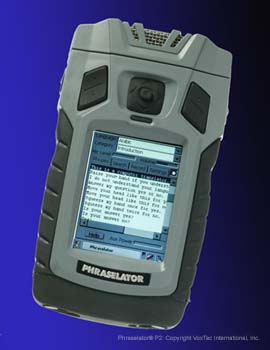
First developed and used in 2001 in Iraq. It was originally just software on a laptop. Currently used by the Military as the unit is far too expensive to be commercially viable. This tough little box is waterproof, shockproof and even fireproof.
The
Phraselator is a small PDA-sized device designed to aid in interpretation. The device does not produce synthesized speech like that utilized by Stephen Hawking; instead, it plays pre-recorded foreign language MP3 files. Users can select the phrase they wish to convey from an English list on the screen or speak into the device. It then uses speech recognition technology called DynaSpeak, developed by SRI International, to play the proper sound file. The accuracy of the speech recognition software is over 70 percent according to software developer Jack Buchanan. The device can also record replies for translation later. The unit can store up to 12,000 pre-recorded phrases in up to 5 languages at a time.
11)
Trek Name: Tractor Beam.

The Tractor Beam is used by star ships to control the movement of objects such as small ships and asteroids. Mostly it is used to tow ships that can no longer move under their own power. Smaller units are used within cargo bay's of the vessels to move equipment too heavy to be moved by hand.
Unit's were also used inside shuttle bay's to bring shuttle craft into the ship, meaning they could make a slow, controlled and very safe landing.
Real Life Equivalent: Tractor Beam.

One of the only times the Star Trek name has been used. Either because the technology is so new they haven't thought up another name for it yet, or because there isn't a better name for it. Names like the levitation beam, or lifting pulse, just don't have the same ring to it and sound like something out of a cheap B-Movie.
Researchers out of the Australian National University have created a device, working in conjunction with other necessary devices, that can literally move small particles with light. And only light! The way it works, is by shining a hollow laser beam around some tiny glass particles. The researchers heat the air around the particles, and therefore cause the dark center of the beam to remain cool. The result is that the particles within drift to the hotter rim (into the laser beam itself), the force of the fast-moving particles within the beam will cause the other drifting particles to move back into the middle.
As of right now, it isn’t powerful enough to move anything other than some particles, but it’s a good first step. And, let’s face it. If you’re a researcher, and you can stand up in a room and say that you’ve created a real tractor beam, that’s pretty amazing.
Sources:
Memory Alpha and
Wikipedia